Should You Have a Writing Journal?
- Jul 19, 2024
- 7 min read
My short answer to this question is yes. But hear me out.
What is a writing journal? It can be whatever you want. You can use it to keep your story outline, ideas for other stories you may want to write, pictures or things that remind you of your story, etc. In general, it can contain anything having to do with writing and/or your story. It doesn’t even have to look like a journal. It could be a notebook, a notepad, or a binder. It’s just something that holds information that will aid you with your writing projects.
When I was fourteen, I started keeping an unofficial writing journal. Though I fancied myself a pantser (someone who writes without planning out the story first), I did write down my story ideas as well as chapters I wanted to write. I called it “My Inspiration Journal” (or “My Insiration Journal” because I forgot the “p” when writing the cursive title). To this day, I look back at all the story ideas I had. Some of them I might write, but others don’t need to see the light of day.
Not only did I write out my story ideas, but I took notes from writing webinars, created character profiles, and worked on writing exercises. I look back on them now and see how much I have grown in my writing. It also reminds me how excited and dedicated to writing I was even before I decided to become a writer. Though it is six years old, my first writing journal is still an inspiration to me today.
This past December, I thought back to my writing journals. At the time, I was obsessed with scrapbooking videos and wanted to try something similar, though I wanted those pages to contain information and not just stickers, tape, and paper. Since I was on Christmas break and enthusiastic about a new year, I decided I wanted to create a new writing journal but fancier.
I’m not saying you have to be fancy with a writing journal. My main goal for this post is to show you how writing journals can help you be inspired and motivated to write. I personally find inspiration through creativity (which included me breaking out the stickers and construction paper), but everyone is different. I just want to share some things that I included in my writing journal that have helped me on my writing journey and may help you too.
So what did I include in my journal?
Plans and Ideas
If you are a planner like I am now, you probably need somewhere to keep your outlines, chapter descriptions, and everything else. A writing journal can help with that.
Chapter descriptions were one of the first things added. Because I wanted to save space (and I was bit lazy), I kept my chapter descriptions to one sentence. In some cases that is helpful, and in others it isn’t. If you just want a general idea of what you want to write about in a certain chapter, or if you know you will go off-script (like I often do), then one-sentence descriptions are good. But if you are like me and forget what you meant when you wrote “Discussion with J” for a whole chapter, then you might want to elaborate.
I also included a cast of characters page. I know it’s probably something I should have done before, but I didn’t. I listed out the names of my characters and what group they belonged to, but I would like to one day create some character sketches to go alongside their names as well as descriptions. You could also print Pinterest pictures if you want faces to some of your characters.
Because I have been working on my current WIP for so long, the only things I included in this writing journal were the chapter descriptions and cast of characters. But you can add so much more. There is a lot that goes into creating a story, and if you are a planner, you probably have or want pages and pages of ideas and notes. Go ahead! My first writing journal where I have my original ideas for my WIP has plot outlines, chapter descriptions, character files, and a summary of the plot. Whatever you need for your story can be kept in your journal.
My current writing journal also has writing ideas, though not just for stories. Yes, I wrote down the titles of story ideas I like and will write one day, but I also wrote down blog post ideas (way before I started building my website). As much as I love having different notebooks for different things, knowing my blog ideas are in my writing journal helps me to stay organized and remember where I put them. If you feel like you’re always digging through notebooks and papers trying to find that one idea, putting all your ideas into one journal or binder might help.
Goals and Reports
Diving into this year (2024), I knew it would be hard to achieve what I wanted to if I didn’t keep myself accountable. I am sure I’m not the only one. It’s easy to be inspired at the beginning of the year, but once we pass the midpoint of January and we get back into the flow of work, school, and real life, it’s easy to slip back into the old way of doing things.
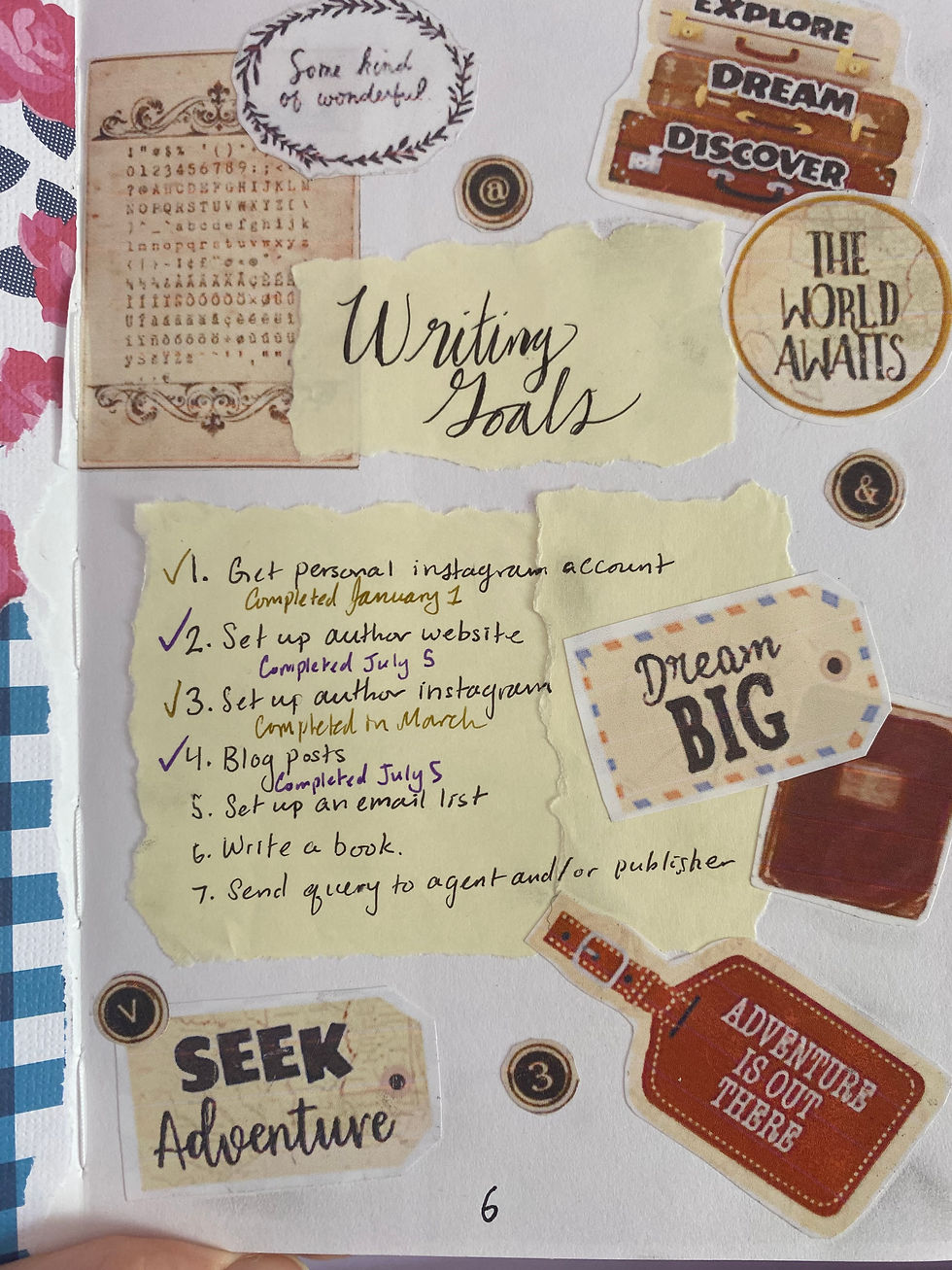
One of the first pages I put into my writing journal this year were my writing goals. Here’s a warning: writing down goals means you must have a very good excuse not to meet those goals, which is why I did it. There’s no “I forgot” or “I ran out of time.” Once I finish a goal, I put a checkmark next to it and write the date underneath. Thay way, I can gauge how long it took me to accomplish a goal and how much time I have left to accomplish the other goals.
It’s one thing to write down goals but another to stay accountable. In my journal, I included a section called “Monthly Reports.” I drew out a calendar for every month this year, and I have to check off the days I write and X out the days I don’t. Writing consistently has always been an issue of mine, especially as motivation disappears. By keeping a calendar, you can see which days you’ve written and determine how much time and writing you have left before a deadline. If there are too many missed writing days, you can see them and try to make up for them.
At the end of every month, I write a report. In this report, I state what I have accomplished, how many words or pages I have in my manuscript, and anything else writing-related that happened. I also admittedly try to justify my missed writing days. Then I decide what I am going to accomplish that next month (which I have to excitedly or ashamedly report on a month later).
This is one way you can keep yourself accountable if you want to write consistently or achieve goals within a certain time frame. This year has definitely been a different year due to these report pages because now I have to see whether I’ve been good or lazy.
If you’ve had a good month, it can be rewarding to see all those checkmarks. But if it has been a slow or disappointing month, admitting that to yourself can make you eager to do better in the next month, and you can determine where changes need to be made.
Something else I report on is my booklist. I have been obsessed with classics lately and I own a few nice-looking ones I want to read. I made it my goal at the beginning of the year to read one a month. I have not kept that up well, but if there are books you want to read or if you need to read more in your genre, then making a booklist and reporting on which one(s) you read that month can help you conquer it.

Extra Pages
In order to motivate and inspire myself, I added some extra fun pages to my writing journal. One of them lists ways to help me be motivated (which I am using as an outline for my “Lacking Motivation and Focus?” series). If I’m not in the writing mood, I can look at the page for ideas, but I also wrote on the side excuses as to why I could take a break if needed (that will be a future blog post).
My favorite pages contain quotes from my favorite books, movies, or Scripture. I found specific quotes that have to do with adventure, books, imagination, and anxiety (since I knew I would be jumping out of my comfort zone this year). For example, “You don’t have time to be timid. You must be bold, daring” (Lumiere in Disney’s 1991 Beauty and the Beast (directed by Gary Trousdale and Kirk Wise)). One of my favorites though is, “It’s not exciting if nothing can go wrong” (Nikolai Lantsov in Leigh Bardugo’s King of Scars (2019)).
These quotes help inspire me because they’re from some of my favorite works, works that are successful and have held a place in my heart since I first experienced them. If you want to contain pages of inspiration in your writing journal, perhaps you can think of books and movies that inspire you or certain lines that have to do with writing or imagination. You can even imagine that your favorite characters are cheering you on.
In short, I use my writing journal to keep what I need for my story and to help inspire and motivate me to make my goals happen. You can be creative with your journal or keep it simple. You don’t necessarily have to have one, but if you want to keep things organized or even want somewhere to keep notes and inspirational quotes, then a writing journal might just be for you!

Bibliography
Hahn, D (Producer) & Trousdale, G. & Wise, K. (Directors). (1991). Beauty and the Beast. [Motion Picture]. United States: Walt Disney Feature Animation.
Bardugo, L. (2019). King of Scars.


Comments